Do Social and Emotional Skills in Childhood Shape Future Success? What a 14 Year Study Found
A 2025 randomized study followed children from preschool through the end of high school. Its findings offer an important clue about why emotional understanding, social competence, and parent involvement deserve a place alongside academic learning.
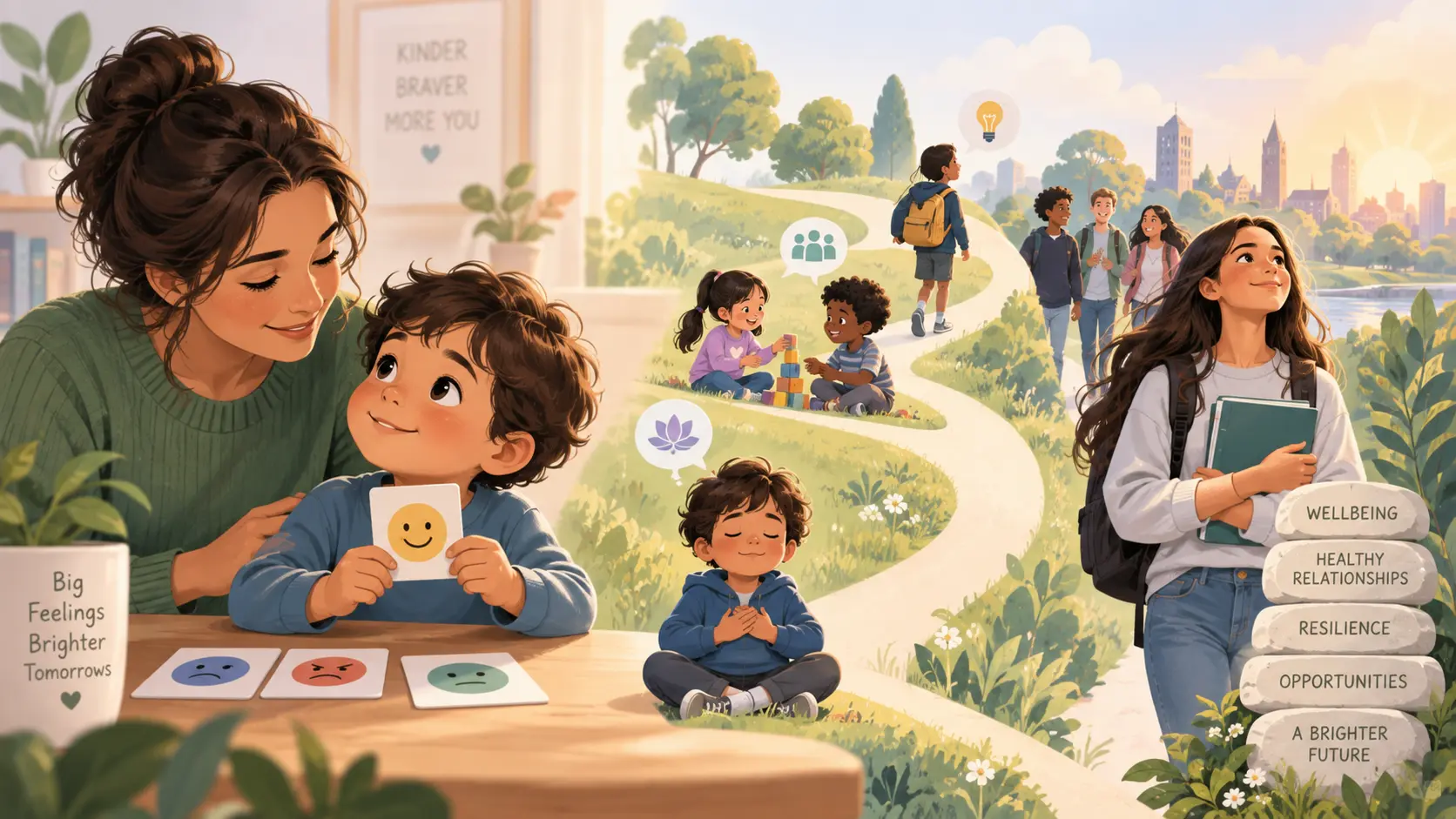
Parents spend enormous amounts of time thinking about their children’s future. We choose schools, read to them, worry about homework, encourage sports, look for activities, and wonder whether they are learning enough. Behind many of those decisions is the same hope: that our child will grow into a capable person who can build a good life.
But some of the abilities that may help children succeed later do not look academic at all when they first appear.
A four year old learning to recognize that they are angry instead of immediately hitting. A six year old figuring out how to recover after losing a game. An eight year old learning what to do after being excluded by friends. A ten year old discovering how to disagree without destroying a relationship.
These can look like ordinary parenting moments. Developmental research suggests they may also be opportunities to build skills that matter far beyond childhood.
A 2025 study published in Child Development provides an unusually powerful perspective on this question. Researchers followed children for approximately 14 years after a social and emotional learning intervention that began when they were in preschool. The results do not show that emotional intelligence guarantees academic or professional success. They show something more scientifically interesting: early gains in specific social and emotional skills were part of developmental pathways associated with how children were functioning many years later.
A rare study followed children from preschool to the end of high school
The research examined 356 children who entered the study at an average age of about 4.5 years. They attended Head Start programs in Pennsylvania, and their classrooms were randomly assigned either to usual Head Start programming or to an enriched program called Head Start REDI. Because assignment occurred randomly at the classroom level, the study offers stronger evidence than research that simply observes which children happen to have stronger social skills and then compares their later outcomes.
REDI stands for Research based, Developmentally Informed. The intervention added intensive social and emotional learning to the existing preschool experience. Its foundation was the Preschool PATHS curriculum, which targeted children’s emotional understanding, prosocial behavior, self control, problem solving, and regulation of emotions and behavior. Teachers also used interactive reading to explore social and emotional themes, received coaching in emotion coaching and problem solving conversations, and shared strategies with parents that could be used at home.
This matters because the intervention was not simply telling children to “be nice” or “control your feelings.” Children were being given repeated opportunities to understand emotions, practice social skills, think through problems, and experience adults responding to emotions in more intentional ways.
Then the researchers waited.
They continued following the children through elementary school, adolescence, and finally high school. The 2025 paper reports outcomes approximately 14 years after the original preschool intervention.
What did researchers find 14 years later?
By high school, adolescents who had participated in the REDI enriched preschool classrooms showed significantly fewer behavior problems and fewer emotional symptoms than adolescents who had received usual Head Start programming. The reported effect size was 0.27 for behavior problems and 0.41 for emotional symptoms.
For an intervention that happened primarily during preschool, the persistence of measurable differences into adolescence is notable. The researchers themselves emphasized that these effects appeared after a very long gap between the original intervention and the high school assessments.
There is an important qualification. REDI did not produce a statistically significant direct effect on high school GPA or on graduating on time. That means it would be inaccurate to say that teaching emotional skills in preschool directly produced higher grades 14 years later.
The more interesting finding appeared when the researchers examined how development unfolded across those years.
Success did not appear as one giant effect. It appeared as a developmental chain
The researchers examined pathways connecting the original preschool intervention with later outcomes. Early REDI related gains in emotion knowledge and social competence contributed to later social adjustment and parent involvement during elementary school. Those changes were then connected with lower levels of behavior problems in high school.
The researchers also found significant indirect pathways connecting the preschool intervention with high school GPA and graduating on time. Some of those paths began with improvements in preschool emotion knowledge or social competence, continued through better social adjustment during elementary school, and then extended toward later academic outcomes.
This distinction is extremely important.
The research does not suggest a simplistic equation where recognizing emotions at age four automatically produces good grades at age seventeen. Human development does not work that way. Instead, the findings are consistent with what researchers sometimes describe as developmental cascades, where an improvement in one area can influence experiences and abilities that matter at the next stage of development.
A child who becomes better at understanding emotions may find social situations easier to navigate. Better social functioning may make classroom participation and relationships easier. Fewer persistent behavior problems may leave more room for learning and engagement. Over many years, these processes can interact.
Future success is not created by one childhood skill. It is built through thousands of interactions between skills, relationships, opportunities, environments, and experiences.
Is this really about emotional intelligence?
Parents usually use the phrase emotional intelligence because it is intuitive. It can refer broadly to recognizing emotions, understanding them, regulating emotional responses, navigating relationships, and responding to other people.
Researchers are usually more precise. The REDI study measured constructs such as emotion knowledge, social competence, social adjustment, emotional symptoms, and behavior problems. The intervention itself targeted emotional understanding, social skills, self control, emotional regulation, and problem solving.
That distinction matters for HeroMi.
We do not need to tell parents that their child must develop some vague quantity called “EQ.” A more useful approach is to break social and emotional development into abilities children can actually practice.
Can my child recognize what they are feeling? Can they communicate what happened? Can they tolerate disappointment without immediately acting on the strongest impulse? Can they think about another person’s perspective? Can they ask for help? Can they solve a social problem? Can they return after a conflict and repair something that went wrong?
Those are much more practical questions.
They are also much closer to the kinds of specific abilities developmental researchers actually study.
This finding does not stand alone
One longitudinal study should never become the entire scientific justification for a parenting method. Fortunately, the REDI findings exist within a much larger body of social and emotional learning research.
A major 2023 meta analysis led by researchers at the Yale Child Study Center examined 424 studies from 53 countries, representing 252 different universal school based social and emotional learning interventions and 575,361 students. Compared with control conditions, participation in these programs was associated with significant improvements across social and emotional skills, attitudes, behavior, peer relationships, school functioning, school climate and safety, and academic achievement.
The Yale team also reported that gains in social and emotional skills remained detectable at follow up periods of six months or longer. At the same time, results varied depending on program design, implementation quality, context, and other factors. That variation matters because “social emotional learning” is not one single intervention and not every program should be assumed to work equally well.
Taken together, the evidence does not support a magical claim that emotional intelligence determines a child’s destiny. It supports a much more credible conclusion: social and emotional abilities are meaningful developmental skills, they can be influenced through intentional learning experiences, and they are connected with outcomes that matter in school, relationships, behavior, and emotional wellbeing.
Why these skills can matter academically even though they are not academic skills
Imagine two children who understand the same math concept equally well.
One child becomes frustrated after making a mistake and cannot return to the task. The other becomes frustrated too, but has gradually learned how to pause, recover, and try another approach.
Both children have mathematical knowledge. Their ability to use that knowledge in real life is influenced by more than mathematics.
The same is true socially. A child can be academically capable and still struggle enormously at school if every disagreement with a peer becomes a crisis, embarrassment leads to withdrawal, frustration leads to aggression, or asking for help feels impossible.
This is why social and emotional development should not be framed as competition with academic learning. Emotional skills do not replace reading, mathematics, science, curiosity, or knowledge. They can help create some of the conditions under which a child is able to participate, persist, cooperate, recover from mistakes, and continue learning.
One of the most important messages from the 14 year REDI findings is therefore not that emotional skills are “more important than grades.” It is that the abilities supporting long term academic functioning may begin much earlier and may include skills that are not traditionally considered academic at all.
This changes how we can look at difficult behavior
Parents usually meet social and emotional development in its least glamorous form.
It does not arrive labeled “today we will build social competence.”
It arrives as a child refusing to lose.
It arrives as a meltdown because plans changed.
It arrives when a sibling grabs a toy and the other child hits.
It arrives when a child lies because admitting the truth feels too uncomfortable.
It arrives when an eleven year old is excluded from a group chat and has no idea whether to confront the friends, pretend not to care, retaliate, or tell an adult.
These situations are exhausting because parents need to deal with what is happening right now. A boundary may need to be held. Someone may need comfort. Unsafe behavior may need to stop.
But the immediate behavior is not always the entire developmental story.
A recurring conflict can also reveal a skill that is not yet reliable. The child may need more practice with frustration tolerance, impulse control, emotional awareness, perspective taking, communication, flexible thinking, problem solving, or repair.
This is one of the central ideas behind HeroMi.
Why HeroMi looks beneath the behavior
HeroMi begins with a simple premise: behavior is often the place where a developing skill becomes visible.
When a child explodes because screen time ends, the immediate goal may be getting through the transition without making the situation more intense. But underneath that moment there may also be a longer developmental task involving frustration tolerance, flexibility, emotional regulation, or shifting attention.
When a child is excluded by friends, the parent may first need to provide safety and connection. Later, the same experience can become an opportunity to practice emotion naming, perspective taking, boundaries, communication, or social problem solving.
When siblings fight, the first priority may be stopping unsafe behavior. Once everyone is calmer, there may be an opportunity to practice repair, accountability, negotiation, or seeing another person’s perspective.
HeroMi is designed to help parents hold both levels at once.
What would help right now?
And:
What skill can this child gradually become more capable of using?
That distinction is fundamental to our approach.
Why we focus on specific skills rather than “good behavior”
“Behave better” is not a skill.
“Be emotionally intelligent” is not a useful instruction either.
Children develop through much smaller abilities that gradually become more sophisticated. A younger child may begin by learning to recognize basic emotions and tolerate waiting for a short period. An older child may be working on handling rejection without retaliation, communicating a boundary, recognizing social pressure, or recovering after making a mistake.
This is why HeroMi guidance is designed around the child’s age, the situation, and the skill involved. The same behavior can mean something very different developmentally at age four and age eleven, and the amount and type of adult support should change accordingly.
The scientific literature does not tell us that one particular HeroMi practice will produce a specific outcome 14 years later. It does support the broader developmental reasoning behind taking these skills seriously.
Why small everyday moments matter
A parent does not usually have a semester called Social Competence at home.
Children learn inside ordinary life.
They learn what to do with anger when someone takes their toy. They learn about disappointment when they cannot have what they want. They learn perspective taking when another child experiences the same situation differently. They learn communication when they need something from us. They learn repair after they hurt someone. They learn persistence when something does not work immediately.
The question is whether those moments become only problems to survive or also, when appropriate, opportunities to practice.
HeroMi is built around this reality. Instead of requiring families to leave everyday life and enter a long educational program every time they want to build a skill, we want to help parents recognize the developmental opportunity inside situations that are already happening.
This does not mean turning every conflict into a lesson. Sometimes children simply need comfort. Sometimes everyone needs to move on. Sometimes the most useful parenting response is brief.
But across months and years, repeated moments create repeated opportunities.
That is where development happens.
The REDI study also tells us something important about parents
One of the most compelling parts of the 14 year analysis involves parent involvement.
The original REDI program did not work with children in isolation. Parents received regular materials illustrating strategies they could use at home, while teachers received coaching in supportive interactions. Later analyses found that parent involvement during the school years was part of several pathways connecting the intervention with high school outcomes. In the model predicting emotional symptoms, parent involvement was the significant mediated pathway connecting REDI with lower emotional symptoms in adolescence.
That does not mean a weekly parenting handout causes better adolescent mental health. The actual developmental pathways are far more complicated.
But it reinforces a principle that matters deeply to us at HeroMi: children do not build social and emotional skills in isolation from the adults around them.
Parents shape the environment in which emotions are interpreted, boundaries are held, conflict is repaired, mistakes are discussed, and children learn what happens when difficult feelings appear.
That is why HeroMi is primarily a tool for the parent.
Our goal is not to put a child alone in front of a screen and ask technology to teach emotional intelligence. The product is designed to support the adult who is already participating in the child’s real life, so that everyday parent child interactions can become more intentional.
From information to practice
Most parents already have access to more parenting information than they can possibly use.
They know that emotions matter. They know children need boundaries. They know yelling is not ideal. They know communication is important.
The harder problem is translating broad principles into the moment in front of them.
What does emotional regulation mean when your four year old is on the floor because you cut the sandwich incorrectly?
What does social competence mean when your eight year old has been deliberately excluded from a game?
What does perspective taking mean when your eleven year old forwarded a private message to gain approval from friends?
This translation from developmental principle to specific situation is the space HeroMi is designed to occupy.
HeroMi helps a parent identify what may be happening, choose an age appropriate response, find practical language to use, and, when useful, turn the experience into a short opportunity to practice an underlying skill. Over time, the goal is not for the family to become more dependent on an app. The goal is for both parent and child to recognize more of these patterns themselves.
What “future success” should mean
There is a temptation to make research like this attractive to parents by immediately talking about college admissions, salaries, or high grades.
That would miss the most important finding.
The strongest direct high school effects in the REDI study were not GPA. They were fewer emotional symptoms and fewer behavior problems.
That matters because a successful future should be bigger than academic achievement.
We want children who can learn, but also children who can recover after disappointment. We want achievement, but also relationships. We want children who can advocate for themselves, recognize what they feel, navigate conflict, ask for help, take responsibility, and repair when something goes wrong.
Academic success can be part of that future.
Emotional wellbeing and the ability to function with other people are part of it too.
How research informs the HeroMi method
Our approach begins with the idea that social and emotional development can be broken into meaningful skills. Instead of treating difficult behavior as a single problem to eliminate, we look at what the child may still be learning.
We then consider developmental fit. Support for a three year old should not look like support for a ten year old because their capacities, relationships, language, independence, and social worlds are different.
We focus on real situations because skills eventually need to function outside a lesson. Children need emotional understanding when they are disappointed, flexibility when plans change, perspective taking during conflict, and communication when something important becomes difficult to say.
We also keep the parent inside the process. Research on REDI did not treat children as isolated learners, and the later findings make parent involvement particularly interesting as part of the developmental pathway.
Finally, we use reflection and repeated practice because the goal is not completion. The goal is greater capability over time.
This is what evidence informed means to us.
Not taking the name of a respected university and attaching it to a product claim.
It means examining what strong developmental research is actually telling us, respecting what it cannot tell us, and using those principles to make better decisions about how we support families.
The bigger lesson for parents
If you are thinking about your child’s future, it is natural to ask what they should know.
How well are they reading? Are they keeping up in math? Should they learn another language? Are they doing enough activities?
Those questions matter.
But the research gives us another set of questions worth asking.
Can my child understand what is happening inside them? Can they recover when something does not go their way? Can they participate in relationships without either disappearing or overpowering other people? Can they solve social problems? Can they ask for help? Can they repair after making a mistake?
These abilities will not guarantee a particular future.
Nothing can.
But the 14 year REDI findings, together with the much broader evidence on social and emotional learning, give parents good reason to treat these capacities as real developmental skills rather than optional extras.
Your child does not need to master them today.
Childhood is where they begin practicing.
Research sources
Bierman, K. L., Heinrichs, B. S., Welsh, J. A., Jones, D. E., and Crowley, D. M.
How a Preschool Intervention Affected High School Outcomes: Longitudinal Pathways in a Randomized Controlled Trial. Child Development. 2025;96(3):1236 to 1249. DOI: 10.1111/cdev.14235. The study followed 356 children from preschool through the end of high school.
Cipriano, C., et al. (Yale Child Study Center)
The State of Evidence for Social and Emotional Learning: A Contemporary Meta Analysis of Universal School Based SEL Interventions. Child Development. 2023;94(5):1181 to 1204. The analysis included 424 studies, 252 interventions, and 575,361 students across 53 countries.
Research transparency: HeroMi is an independent educational parenting product. HeroMi is not affiliated with, evaluated by, or endorsed by Penn State University, Yale University, the researchers discussed in this article, Preschool PATHS, or Head Start REDI. We use independent developmental and parenting research to inform the principles behind our educational approach.
Editorial note: HeroMi provides educational parenting information and tools. It does not provide medical or mental health diagnosis or treatment.
Yes. Research suggests that social and emotional skills in childhood are connected with later outcomes in wellbeing, behavior, relationships, school functioning, and academic achievement. A 2025 randomized study followed children for approximately 14 years after a preschool intervention and found lower emotional symptoms and behavior problems in high school among children who received the enriched program. The intervention did not directly improve GPA or graduation rates, but researchers identified significant indirect developmental pathways connecting earlier gains in social and emotional skills with later academic outcomes.
Yes. Social and emotional abilities may support some of the processes children need in order to function successfully at school, including regulation, social adjustment, problem solving, cooperation, persistence, and managing behavior. A large 2023 Yale led meta analysis of 424 studies found that social and emotional learning interventions were associated with improvements in academic achievement as well as social and emotional skills, behavior, relationships, and school functioning. This does not mean emotional intelligence is more important than academic ability or guarantees better grades.
Rather than thinking about emotional intelligence as one ability, it can be more useful to think about specific skills. These include recognizing emotions, communicating feelings and needs, regulating emotional responses, tolerating frustration, considering another person’s perspective, solving social problems, asking for help, adapting when circumstances change, and repairing relationships after conflict. The skills that are realistic and important will change considerably with the child’s age and development.
Research on social and emotional learning indicates that specific social and emotional abilities can be supported through intentional learning experiences. The REDI randomized intervention improved targeted preschool skills including emotion knowledge and social competence, while the much larger Yale meta analysis found significant improvements in social and emotional skills across many different interventions. Results vary across programs and contexts, so no single activity or method should be assumed to work for every child.
Early childhood provides repeated opportunities for children to begin practicing emotional understanding, regulation, communication, social problem solving, and other developing abilities. The 14 year REDI study is particularly interesting because early gains in emotion knowledge and social competence were part of pathways associated with social adjustment, behavior, and later academic outcomes. The research does not mean early childhood determines a child’s future, but it suggests that early social and emotional development deserves serious attention.
Parents can help by using the situations that already occur in family life. A conflict can become an opportunity to practice repair. Disappointment can become practice in recognizing and tolerating emotion. A friendship problem can create opportunities for perspective taking, boundaries, and problem solving. The aim is not to turn every experience into a lesson, but to recognize repeated situations where a child could benefit from developmentally appropriate support and practice.
HeroMi is an educational parenting tool designed to help parents understand difficult everyday situations, identify skills that may be involved, choose age appropriate responses, and use short practices and reflection when appropriate. HeroMi is informed by developmental and parenting research, but the independent studies discussed in this article did not evaluate HeroMi and should not be interpreted as evidence that HeroMi itself produces the same outcomes.
The moment is temporary. The skill can stay.
Everyday challenges can reveal the skills your child is still learning. HeroMi helps you understand what may be happening, know what to do now, and find age appropriate ways to build emotional and social skills through real family life.