What Harvard Research Says About Building Self-Regulation in Children
Harvard researchers have been studying how children build executive function and self-regulation and why small, targeted practice in everyday life may matter.
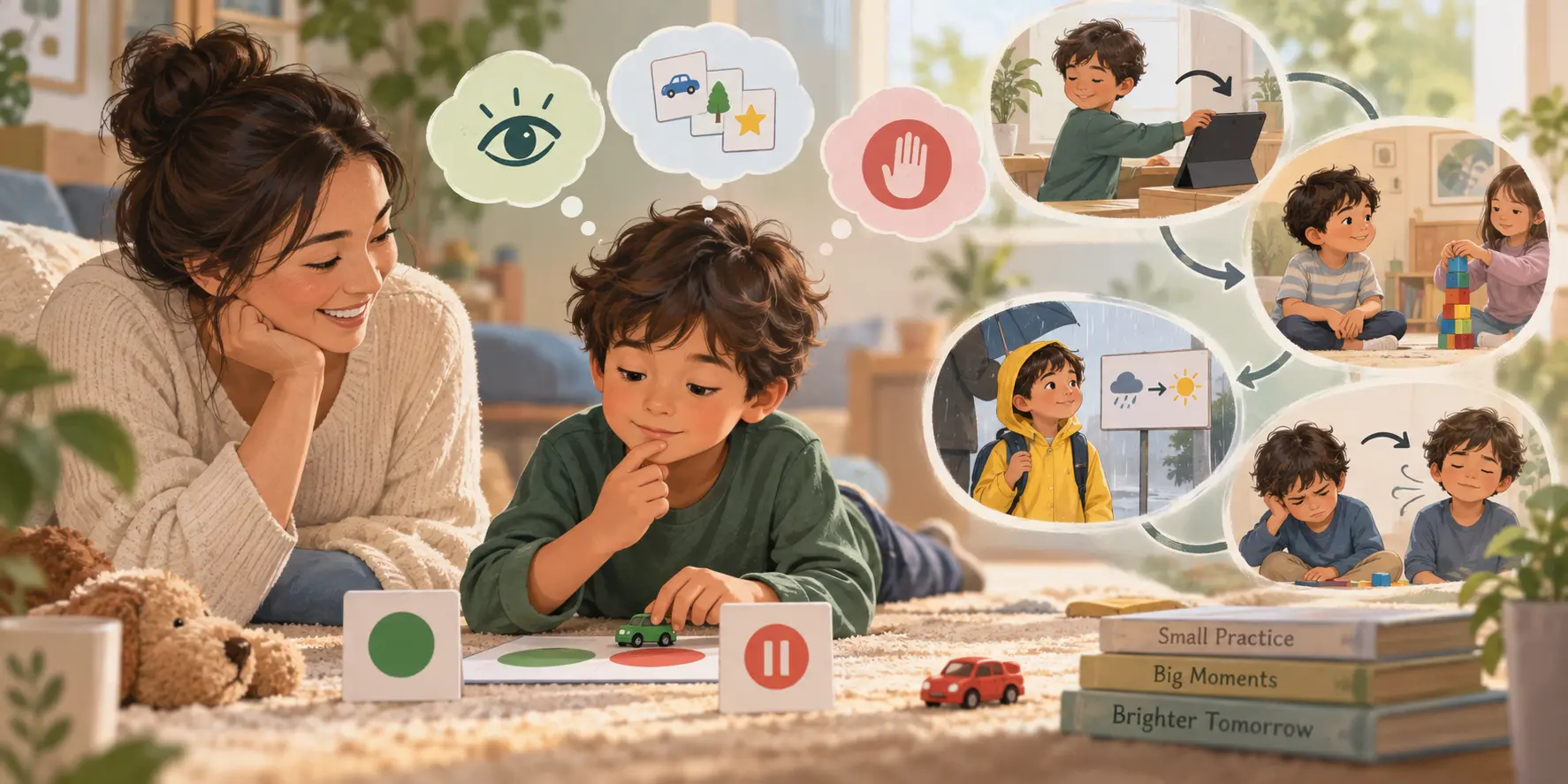
A child knows they are supposed to wait for a turn and grabs the toy anyway. They know screen time is over but the moment the tablet disappears, everything falls apart. They promise they will not yell at their sibling again, then do exactly that ten minutes later.
For parents, these moments can be incredibly frustrating because the child often knows the rule. So why can’t they just do what they already know?
Part of the answer may lie in a set of developing abilities psychologists call executive function and self-regulation. Researchers at Harvard have spent years studying these skills, how they develop, and how children may be supported in practicing them.
The important idea for parents is surprisingly hopeful: self-regulation is not simply a personality trait that some children are born with and others lack. It involves developing skills and skills can be practiced.
That does not mean there is a quick trick that makes a four-year-old calmly accept every “no.” It means that many difficult behaviors can be looked at through a different lens:
Not only “How do I stop this behavior?” but also “What skill is my child still learning here?”
What does self-regulation actually mean?
Self-regulation is often reduced to “being calm,” but that is only part of it.
Harvard’s Center on the Developing Child describes executive function and self-regulation as core capacities that help people manage information, focus attention, make decisions, plan, adapt, and control responses. Harvard often uses the image of an air traffic control system: many things are happening at once, and the brain has to decide what to focus on, what to ignore, what to remember, and what to do next.
For a child, these developing abilities are involved in ordinary moments all day long.
A preschooler needs them to hear “we’re leaving the playground” while wanting desperately to stay. A seven-year-old needs them to stop before hitting back when a sibling provokes them. A ten-year-old uses them to remember instructions, shift plans when something changes, manage frustration with difficult schoolwork, and think before sending an angry message.
This is one reason “they know better” does not always translate into “they can do better right now.”
Knowing the rule and being able to use that knowledge while frustrated, excited, embarrassed, tired, or angry are not exactly the same task.
New Harvard research makes these skills especially relevant
In March 2026, researchers including Stephanie Jones and colleagues at the Harvard Graduate School of Education published a large longitudinal study in Child Development examining executive function development in children ages 3 through 11.
The study analyzed data from 3,107 children collected between 2018 and 2023. Researchers found that after the onset of the COVID-19 pandemic, the average rate of executive-function growth in the sample was lower than expected based on previous developmental norms and research. The estimated difference in the rate of growth was approximately 0.5 standard deviations, with broadly similar patterns across socioeconomic groups.
This finding should not be interpreted as “the pandemic permanently damaged children’s brains,” nor does it mean every individual child experienced the same change. It does, however, add to the case for paying serious attention to the everyday skills children use to manage attention, behavior, plans, and emotions.
And another line of research from Harvard asks an important practical question: How might we help children practice those skills?
Harvard researchers tested a surprisingly simple idea
At Harvard’s EASEL Lab - the Ecological Approaches to Social Emotional Learning Laboratory - researchers have explored ways to make social-emotional skill building easier to integrate into real life.
One example is an intervention called Brain Games.
Instead of relying only on a large curriculum taught in lengthy lessons, Brain Games included 31 short activities designed to fit into ordinary classroom routines and transitions. Each activity targeted specific executive-function processes, organized around attention, working memory, and inhibitory control.
The philosophy is important.
Children did not simply receive a lecture about why self-control matters. They practiced a particular skill through an activity. Afterward, teachers helped children notice what they had just used and think about where else that same ability might help them.
In other words: Practice the skill. Name the skill. Recognize where it is useful. Use it again.
That is very different from waiting until a child loses control and then saying, “You need to learn some self-control.”
What happened in the randomized study?
Harvard researchers evaluated Brain Games using a classroom-randomized experimental design involving 626 children across 36 pre-K through fourth-grade classrooms.
The results were promising in some analyses but importantly, they were mixed.
In one set of statistical models, researchers found positive effects on measures including global executive function, prosocial behavior, and attention control or impulsivity. Other analyses produced weaker, null, or contradictory findings. The researchers found no significant effects on several direct measures of inhibitory control, working memory, or teacher-student relationships.
That nuance matters.
This study does not prove that five minutes of games will transform a child’s self-regulation. It does not show that every brief activity works, and it certainly does not demonstrate that any parenting app using short practices is automatically effective.
What it does provide is evidence worth continuing to investigate: targeted, relatively low-burden activities that can be integrated into ordinary environments may be a viable way to practice regulation-related skills. The study’s authors themselves described the results as a signal that deserves larger and more tightly controlled research.
The bigger Harvard idea: “kernels” of practice
The Brain Games work contributed to a broader approach developed by Stephanie Jones and the EASEL Lab known as kernels of practice.
A kernel is essentially a small, targeted strategy focused on a particular social-emotional skill or process. Rather than requiring every child to move through the same large program in exactly the same way, the researchers have explored whether smaller practices can be selected and adapted based on a learner’s needs, skills, goals, and context.
Harvard’s EASEL team has described the goal as developing approaches that are lower-burden, flexible, sustainable, and capable of being personalized. The team has also explored kernels beyond executive function, including areas such as perspective-taking, empathy, and emotion understanding.
For parents, that idea makes intuitive sense.
A child who struggles to wait their turn does not necessarily need the same support as a child who becomes overwhelmed when plans suddenly change. A child who cannot find words when angry may need something different from a child who understands their emotions but struggles to see another person’s perspective.
“Emotional intelligence” is enormous.
Skills are specific.
This changes the way we can look at difficult behavior
Imagine your five-year-old has a meltdown every time you turn off the TV.
It is easy to frame the entire problem as: “My child doesn’t listen.”
But look more closely and several developing skills may be involved. Your child may need to shift attention away from a highly engaging activity, tolerate disappointment, inhibit the impulse to protest physically, process what comes next, and recover emotionally from a limit they did not choose.
That does not mean the boundary disappears.
It means behavior can simultaneously require a limit and reveal an area where the child needs practice.
Consider another situation. Your eight-year-old comes home furious because a friend excluded them and immediately says something cruel about that child.
The immediate parenting question is not only whether the words were acceptable. The situation may also involve emotion identification, impulse control, perspective-taking, social problem-solving, and the ability to decide what to do when hurt.
Instead of treating every difficult moment as an isolated behavioral problem, we can start to see patterns underneath it.
And patterns give parents something much more useful than blame: something to practice.
Why practicing before the hard moment matters
Parents often try to teach emotional skills at exactly the moment when children are least able to use them.
A child is screaming, and we say: “Use your coping skills.”
Two siblings are fighting, and we suddenly expect sophisticated conflict resolution.
A child has just been rejected by a friend, and we immediately ask them to consider the other child’s perspective.
Sometimes teaching needs to happen later.
Harvard’s executive-function resources emphasize that these capacities develop through interactions and opportunities for practice. The Center on the Developing Child even provides age-specific activity guides extending from infancy through adolescence.
That suggests an important distinction:
The difficult moment shows us the skill. The calmer moment gives us a chance to practice it.
Over time, the child may have more chance of accessing that skill when the next difficult moment arrives.
What this looks like at home
Parents do not need to turn home into a therapy room or create a daily social-emotional curriculum.
A more realistic approach is to notice a recurring challenge and identify one skill underneath it.
If your child struggles whenever plans change, you might practice flexibility in playful, low-stakes situations. Change one small rule in a familiar game and practice adjusting. Make two possible plans for the afternoon and talk about how you would switch if Plan A does not work.
If your child acts before thinking, games that require waiting, stopping, remembering rules, or changing responses can create opportunities to practice inhibitory control without a lecture.
If your child struggles to tell you what they feel, you can build emotion vocabulary when everyone is calm rather than demanding a sophisticated emotional explanation in the middle of a meltdown.
And after the practice, one tiny reflection can help connect the activity to real life: “What helped you stop and think that time?” or “Where else could you use that?”
The goal is not to make a child analyze every experience. It is to help them gradually recognize that a skill they practiced in one context can also be useful somewhere else.
From stopping behavior to building capability
This is the part of the research that matters most to us at HeroMi.
Many parenting resources are organized around problems:
How do I stop tantrums?
How do I get my child to listen?
How do I stop sibling fighting?
How do I make bedtime easier?
Those are valid questions. When a parent is in a hard moment, they need practical help, not a neuroscience lecture.
But if support ends with making one difficult moment disappear, we may miss something bigger.
At HeroMi, we look at everyday parenting situations through two lenses:
What can help this family right now?
and
What underlying skill could this moment help the child practice over time?
That is why HeroMi practices are intentionally short, age-aware, and connected to specific situations rather than organized as one long generic course in “emotional intelligence.”
A difficult transition might become an opportunity to practice flexibility. A sibling conflict may eventually become practice in perspective-taking and repair. A moment of frustration can lead to work on coping, communication, or self-regulation. A painful friendship problem may involve emotional awareness, boundaries, problem-solving, or asking for help.
The immediate situation matters.
But so does the capability underneath it.
Where HeroMi and the Harvard research align
HeroMi was not developed by Harvard, Harvard has not evaluated HeroMi, and the Brain Games study did not test our product.
That distinction is important.
What we can say is that several principles explored in Harvard’s research closely align with how HeroMi is designed.
1) Target one skill instead of trying to teach everything
The EASEL work breaks large concepts like social-emotional learning into more specific processes and strategies. HeroMi similarly connects practices to particular skills rather than treating emotional development as one vague ability.
2) Keep practice small enough to fit real life
Harvard researchers have explicitly investigated lower-burden strategies that can fit into everyday routines rather than existing only as lengthy standalone programs. HeroMi practices are designed around the same practical reality: most parents do not have 45 minutes for a parenting lesson when they need help before school, after a conflict, or at bedtime.
3) Personalize the practice to the context
Harvard’s kernels work has explored selecting strategies based on specific skills, goals, and needs. HeroMi applies a related principle in the family context by considering the child’s age, the situation, and the skills being developed when surfacing guidance.
4) Connect practice back to everyday situations
In Brain Games, children did not only complete an activity. Teachers also helped them think about how the skill could be used elsewhere. HeroMi uses short reflection for a similar reason: the ultimate goal is not completing activities inside an app. It is helping skills become recognizable and useful outside it.
This is an important part of our philosophy:
A practice is not the outcome. The skill becoming usable in real life is the outcome.
What HeroMi is and what it is not
Evidence-based parenting has an important responsibility: not to turn good research into claims it cannot support.
Harvard has not shown that every short intervention improves self-regulation. Research on executive-function interventions remains complex, and outcomes vary considerably depending on the skill, measurement, child, context, intervention, and study design. The Brain Games trial itself contained both positive and null findings.
HeroMi therefore should not be understood as a treatment for ADHD, autism, anxiety, behavioral disorders, or any other medical or mental health condition. It is not a substitute for a pediatrician, psychologist, therapist, or individualized clinical care.
HeroMi is designed as an educational parenting tool: to help parents understand difficult everyday situations, find practical age-aware responses, and create more opportunities to practice useful emotional, social, and self-regulation skills together.
The science gives us principles to build from. Our responsibility is to apply them carefully.
Five things parents can take from the research
The most useful interpretation of this research is not “do more activities with your child.” Most families already have enough things to do.
Instead, try thinking differently about the moments you already have.
Look beneath the behavior. When a difficult situation repeats, ask which developing ability might be involved - waiting, shifting, remembering, communicating, calming, problem-solving, or seeing another perspective.
Choose one skill. “Be better behaved” is impossible to practice. “Pause before grabbing,” “name what I feel,” or “try another plan” is much more concrete.
Practice when the stakes are low. The middle of an emotional explosion is often not the best classroom. Create small opportunities to use the skill during ordinary play and family routines.
Name what worked. Afterward, help your child notice the process: “You really wanted to go first, and you waited.” This makes the invisible skill easier to recognize.
Bring it back to real life. When the same challenge appears later, connect it gently: “Remember how we practiced stopping before we moved? Let’s try that here.”
No single practice will change a child overnight. That is not how development works.
Children are not supposed to have adult self-control
There is another important reason this perspective matters. When we see self-regulation as a developing capacity, our expectations can become more realistic. Young children are not miniature adults who happen to behave badly. Their ability to remember rules under pressure, inhibit impulses, tolerate frustration, switch attention, plan ahead, and regulate emotion is still developing.
Harvard’s Center on the Developing Child emphasizes that executive-function capacities are not fully formed at birth; they develop over time and are supported by the environments and experiences surrounding children.
That does not mean children should never have boundaries or consequences.
It means a boundary can answer: “What needs to happen right now?” while practice answers: “What does my child need to become more capable of doing over time?”
Both matter.
The goal is not a perfectly regulated child
Children will lose control. They will make impulsive decisions. They will forget something you have explained twelve times. They will become jealous, angry, overwhelmed, embarrassed, inflexible, or deeply disappointed.
Development is not the elimination of those experiences.
The goal is for children to gradually build a larger repertoire of things they can do when those experiences happen: pause, communicate, adapt, ask for help, recover, repair, reconsider, and try again.
And that changes the question parents have to answer.
Instead of only: “How do I get through this difficult moment?” we can also ask: “What could my child be learning through it?”
That is where everyday parenting starts to look less like a sequence of problems to solve and more like thousands of small opportunities to build capability.
One skill at a time.
Research sources
Jones, S. M., et al. The Impact of the COVID-19 Pandemic on Young Children’s Executive Function: A Longitudinal, Population-Based Study. Child Development. Published March 24, 2026. DOI: 10.1093/chidev/aacag003.
Barnes, S. P., Bailey, R., & Jones, S. M. Evaluating the Impact of a Targeted Approach Designed to Build Executive Function Skills: A Randomized Trial of Brain Games. Frontiers in Psychology. 2021;12:719645. DOI: 10.3389/fpsyg.2021.719645.
Harvard University, Center on the Developing Child. A Guide to Executive Function.
Harvard Graduate School of Education, EASEL Lab. Brain Games and Kernels of Practice research resources.
Research transparency: HeroMi is not affiliated with or endorsed by Harvard University. The studies and resources discussed above did not evaluate HeroMi. We use independent research to inform the principles behind our educational parenting tools.
Editorial note: HeroMi provides educational parenting information and tools and does not provide medical or mental health diagnosis or treatment.
Self-regulation is a broad ability involving the management of attention, emotions, thoughts, and behavior. It relies partly on developing executive-function skills such as working memory, mental flexibility, attention control, and inhibitory control. For children, these skills are involved in everyday tasks such as waiting, following instructions, switching activities, coping with frustration, thinking before acting, and recovering after becoming upset.
Self-regulation and executive-function capacities develop throughout childhood and can be supported through developmentally appropriate experiences and opportunities for practice. Harvard’s Center on the Developing Child describes these capacities as skills that are not fully developed at birth and can be strengthened through supportive environments and practice. No single game or activity is guaranteed to improve a child’s self-regulation, however, and research on specific interventions shows mixed results.
Harvard researchers studied Brain Games in 626 children across 36 pre-K through fourth-grade classrooms. The short activities targeted attention, working memory, and inhibitory control. Some analyses found positive effects on executive-function-related and prosocial outcomes, while others found no significant effects on several direct measures. The researchers described the findings as promising but preliminary and called for further research.
Start with one specific skill rather than trying to teach “self-control” in general. For example, children can practice waiting, stopping before acting, changing plans, remembering instructions, naming emotions, or considering another person’s point of view through short everyday activities. It can also help to practice when the child is relatively calm and later connect the skill back to real situations.
No. The concepts overlap but are not identical. Executive functions include processes such as working memory, attention control, mental flexibility, and inhibition. These processes can support the broader ability to regulate emotions and behavior, but emotional regulation also involves additional emotional, social, developmental, and contextual factors.
HeroMi is an independent educational parenting product and is not affiliated with or endorsed by Harvard University. However, several principles in HeroMi’s approach are consistent with areas explored in Harvard research, including targeted skill practice, age-appropriate activities, integration into everyday situations, personalization to specific needs, and reflection designed to help children recognize where a skill may be useful.
Turn everyday moments into skills
When something is hard for your child, HeroMi helps you look beyond the behavior, understand what may be happening, and find practical, age-aware ways to respond and build the skills underneath it.